[Fork about and find out]
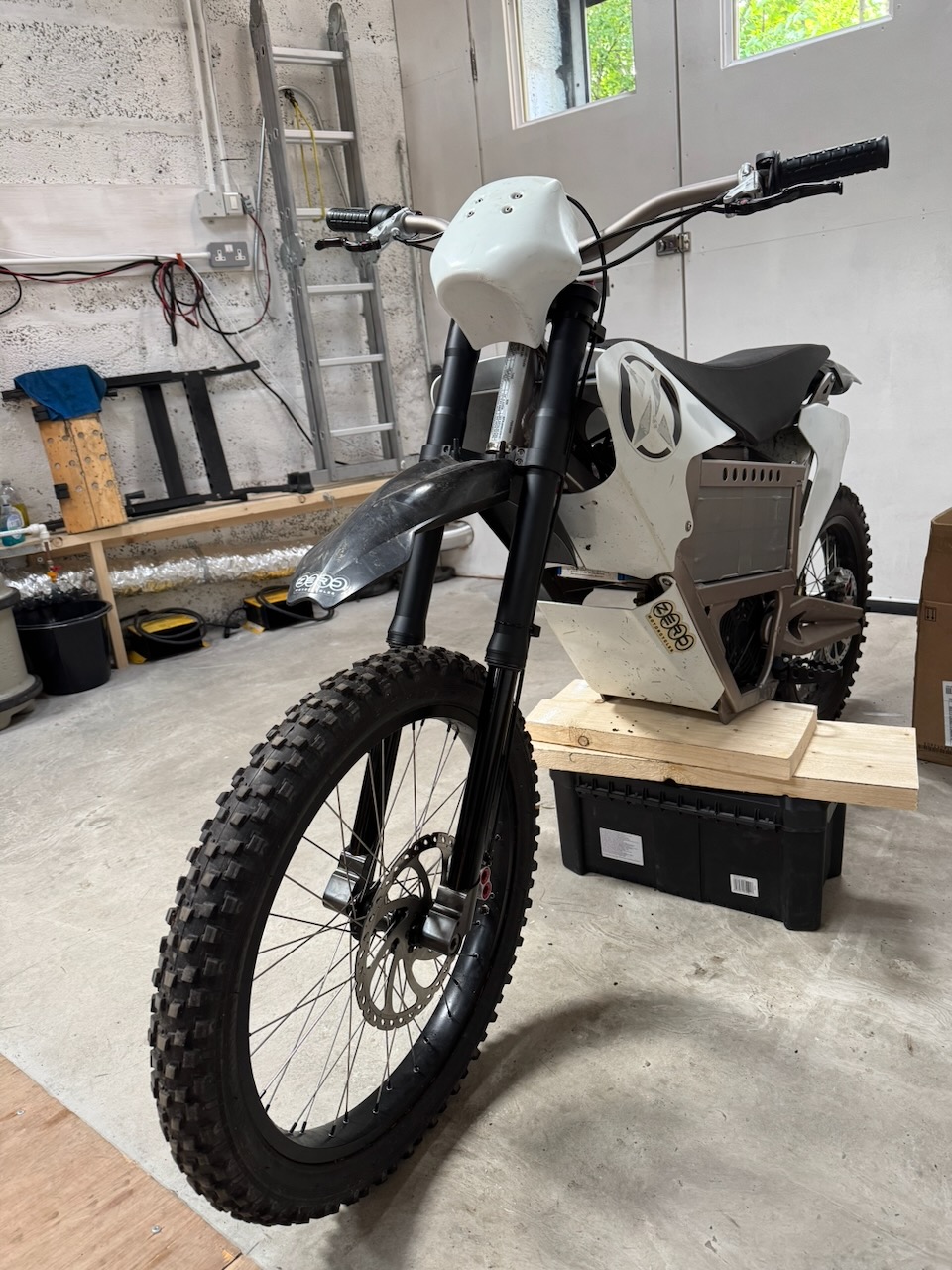
Here I’m documenting the things about this bike that I couldn’t find out anywhere else. This post will be updated as I find out more.
FORKS
They look cool AF but have no identifying markings and there is no service information to be had anywhere. Google AI thinks they were Zero’s own design.
They had absolutely no damping and made horrible clunking noises, so we (myself and the bike’s actual owner 🙂 ) decided to open them up and try to service them anyway. Sorry for the lack of pics.
They turned out to have a quite similar design to mountain bike forks that I’ve serviced in the past, like the Rock Shox Pike and Domain. Indeed the Zero has a standard 1 1/8″ threadless MTB headset, and downhill MTB forks would probably fit and work well.
The left hand leg (the one with the brake caliper) contains a coil spring. The adjuster knob on top is coil spring preload. There is an air valve in the bottom of this leg that just seems to generate more preload. We added a small amount of oil to this leg and put it straight back together.
The right hand leg is a combined air spring and damping cartridge. The adjuster knob is rebound damping.
This one was squirting oil from a blown O-ring when we got it. We replaced all of the O-rings with ones from a kit bought from Amazon. 🙂 They seem to be metric but a bit fatter than the most popular metric sizes.
To open this leg you have to release any air pressure, unscrew the top, empty out the oil (there was practically none left) and compress it fully, which will reveal a nylon nut on top of the inner leg. Undo this nut and the damper innards will come out of the inner leg, which can then be slid out of the outer if desired.
This leaves a floating air piston in the bottom of the inner leg which can be ejected with air pressure to the Schrader valve. (If you forgot to release the air pressure, it has already hit you in the forehead.) The piston has 2 O-rings that probably need replaced too.
We had to figure out the oil volume for this leg by trial and error, by adding more until the damping started to work. It ended up about 250ml. I tried searching for this info online, but the internet couldn’t decide if it was 85ml or 350…
10wt Castrol motorcycle fork oil was used, because that was what Halfords had on the shelf. 🙂 40psi of air pressure in the coil spring leg and 85-100psi in the damper leg felt about right.
ORIGINAL BATTERY
The original battery was completely missing. It died on the previous owner and got lost when it was sent back for repair.
It was a 14S12P arrangement of Molicel 26700 lithium ion cells. These were some of the first high-drain cells, capable of much higher discharge currents than the typical laptop battery.
After studying the construction I can’t imagine how this battery could have failed prematurely 🙂 but here we are…
MOTOR
A Motenergy ME0708 brushed permanent magnet DC motor. Capable of 4.8kW continuous and 15kW (20.1hp) for one minute.
CONTROLLER
An Alltrax NPX 300A model with custom firmware for Zero. Not reprogrammable or tunable.
DASHBOARD
Has a LED bargraph voltmeter, a LED that turned green when I stuffed that resistor in the battery temperature sensor plug, and two switches: 25/50mph speed limit and low/high torque.
The power has to be cycled using the ignition key or handlebar kill switch to make these switch settings take effect.
More info: The LED goes solid green when the bike is ready to roll and flashes various error codes when there’s a problem. I verified 6 flashes for battery undervoltage lockout, the other suggestions might be AI hallucinations…
I opened up the dash and it looks hella complicated! There is a Microchip dsPIC in there. I think it must be performing some kind of throttle mapping to make the bike feel less like a golf cart 🙂 The Alltrax controller has a half throttle input, but it isn’t connected to anything.
Leave a Reply